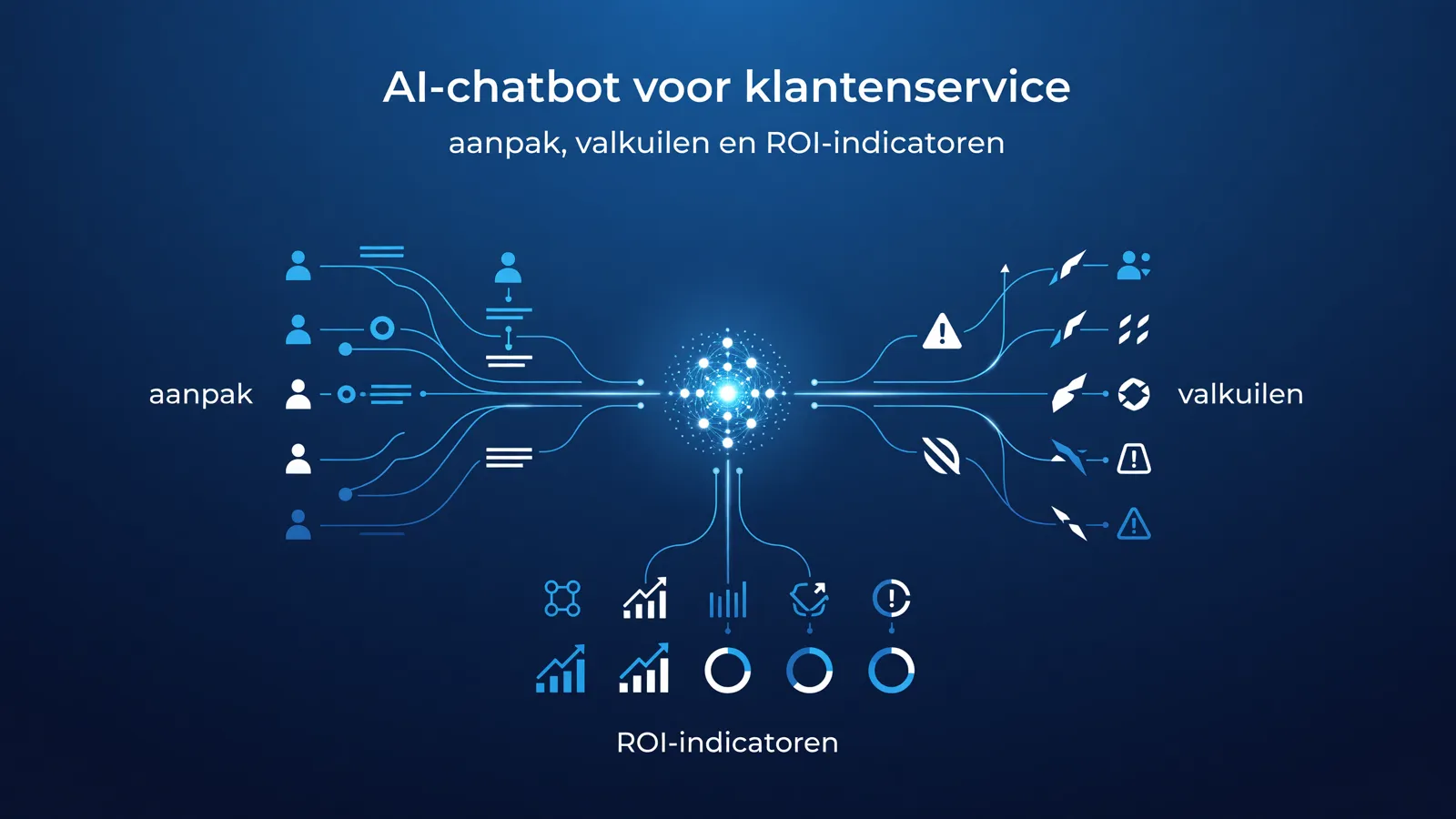
The integration of Large Language Models (LLMs) into customer service operations is rapidly shifting from an experimental phase to a strategic necessity. Organizations realize that traditional rule-based chatbots no longer meet the expectations of the modern B2B and B2C customer. In this analysis, we discuss the architecture, pitfalls, and measurable ROI indicators of a successful AI implementation.
1. The Phasing: From Audit to Production
A successful rollout requires a strict, phased approach to minimize business risks.
- Phase 1: Data Audit and Scope. The model is only as good as the underlying data. This phase determines which historical tickets, FAQs, and product manuals are suitable for access.
- Phase 2: Architecture and RAG Implementation. Instead of training a model (fine-tuning), Retrieval-Augmented Generation (RAG) is used. Here, the system searches for the correct internal context via a vector database before the answer is generated.
- Phase 3: Testing Phase and Red Teaming. Simulating edge cases and aggressive prompts (red teaming) to ensure the bot remains polite, safe, and within the set domain boundaries.
- Phase 4: Controlled Rollout. Start with a 'Human-in-the-Loop' (HITL) setup where the AI generates initial draft answers for employees before transitioning to direct customer interaction.
2. Data Requirements and Hallucination Risks
The greatest risk of LLMs in a business environment is 'hallucination': the convincing presentation of incorrect information. Within customer service, this can lead to reputational damage or unjustified commitments to customers.
To combat hallucinations, the model must be strictly grounded in your own data. By converting business documents into vector embeddings, you force the LLM to answer exclusively based on the retrieved, verified paragraphs. Want to learn more about the technical foundation behind this? Read our documentation on RAG and Vector Search.
Additionally, the strict separation of public and personal data (PII) is crucial. Models must never be trained on untrained customer data; the integration requires an anonymization layer in the API connection.
3. Measurable ROI Indicators (KPIs)
An AI chatbot must be evaluated on hard, measurable KPIs to demonstrate the return on investment (ROI). Pay attention to the following indicators (figures serve as a market indication):
Conclusion
Deploying an LLM for customer service offers significant operational efficiency, provided that fundamental risks regarding data isolation and hallucinations are mitigated in the architecture. Companies that invest in clean data and a robust RAG infrastructure are building a decisive competitive advantage now.